
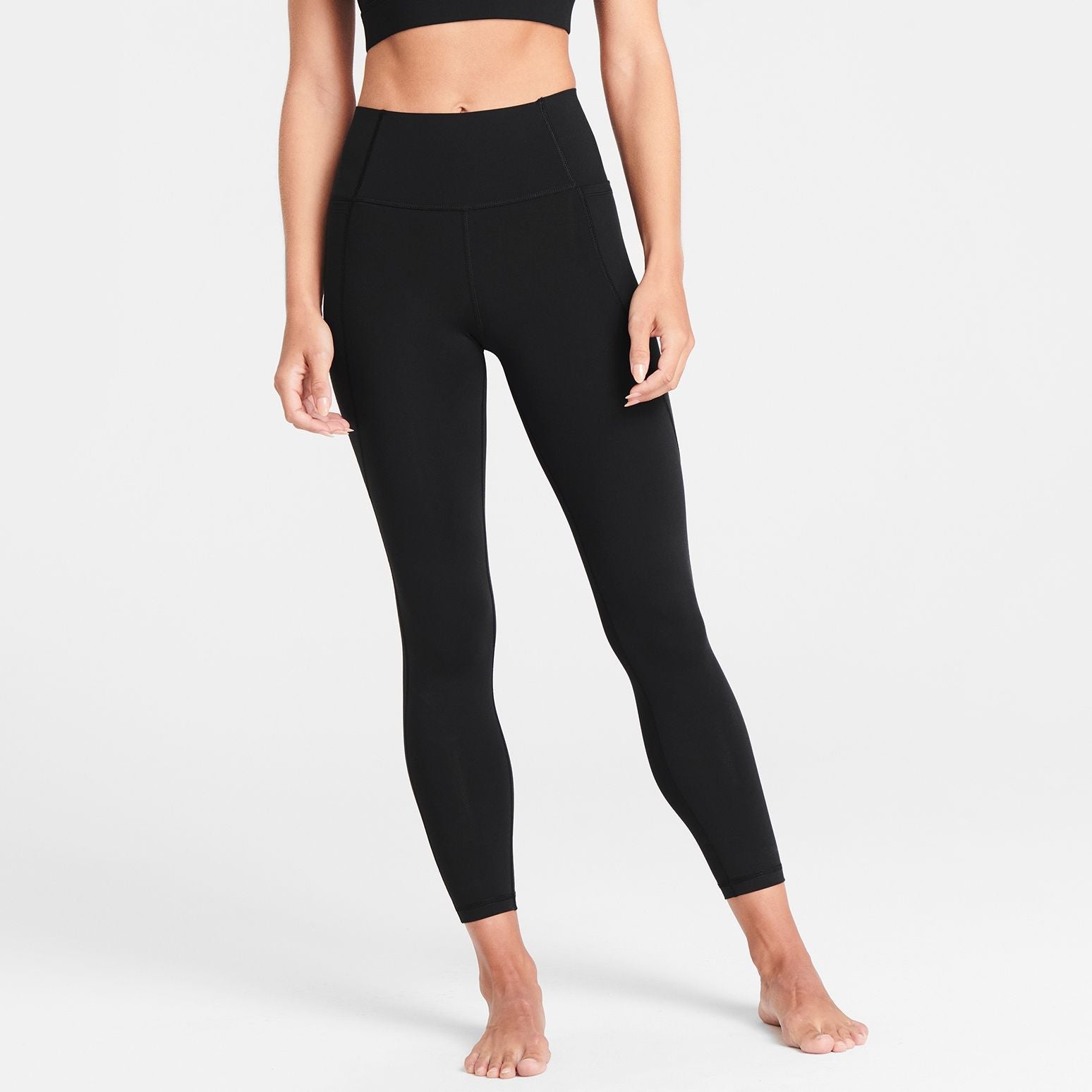


Why performance fabrics exist
What synthetic fibers actually do
Synthetic fibers — nylon, polyester, elastane — power activewear because of what they are engineered to do:
- Stretch and recover, so leggings hold their shape through a full session
- Transport moisture, so sweat moves off skin rather than sitting against it
- Resist wear, so a garment survives hundreds of training cycles
- Provide compression, so movement is supported under load
These aren't marketing properties. They're the reason high-performance activewear works.
This is where many "organic-only" activewear options struggle in practice. Natural fibers can feel soft initially, but under repeated sweat, stretch, washing, and drying cycles, they often lose shape, sag at the knees or waistband, absorb moisture, and break down faster. That may work for casual loungewear — but it rarely delivers the durability, recovery, and long-term performance needed for real training.
The certification gap
"Organic" isn't automatically safer
Organic cotton starts cleaner than conventional. That's real. But the path from organic fiber to finished garment includes dyeing, finishing, and assembly — any of which can introduce residual chemistry. Independent testing has repeatedly shown that even organic-labeled garments can carry residue that raw fiber-level certifications don't capture.
Organic describes the input. Not the output.
Journalist Alden Wicker explored this directly in her piece "Greenwashing Alert: Organic Clothing Can Be Toxic", highlighting how consumers often assume "organic" automatically means chemically clean — even though dyes, finishes, inks, and downstream processing can still introduce substances the shopper never sees listed on a label.
That distinction matters because most certifications focus on raw fibers or fabric stages, not the finished garment consumers actually wear against their skin.
The elastane reality
Where elastane fits in
Almost every performance garment — including most products marketed as "natural fiber" or "organic" — contains elastane (also called spandex) for stretch and recovery. The 92% organic cotton + 8% elastane formula common in clean-cotton brands is, by design, a synthetic blend.
The question isn't whether activewear contains synthetics. It's whether the brand has tested the finished garment for what's actually in it.
What to ask instead
What actually determines safety
Three questions cut through the noise:
The real checklist
- Has the finished garment been independently lab-tested?
- Was the testing for specific substances of concern — PFAS, BPA, phthalates, restricted dyes?
- Are the results from an accredited lab, and available to share on request?
If yes to all three, the question is answered.
